
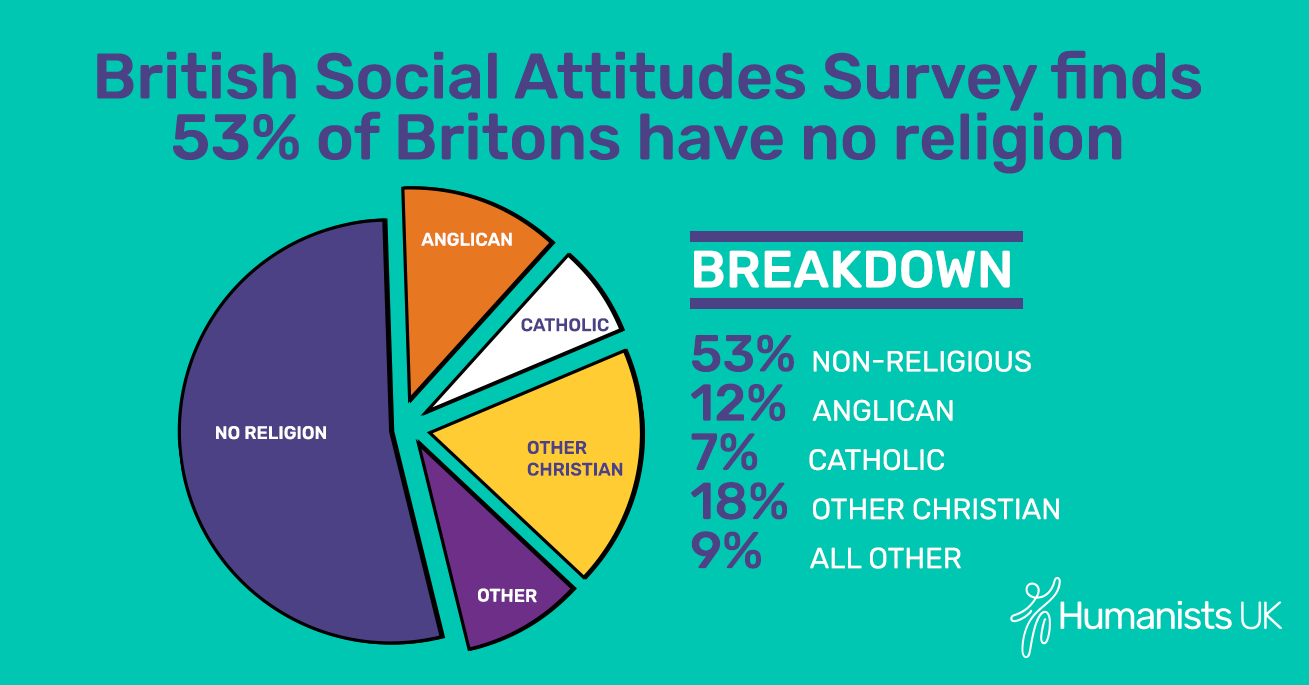
 The latest British Social Attitudes Survey has shown that the share of the population belonging to no religion has continued to grow, now standing at 53%, with 12% Anglicans, 7% Catholics, 18% other Christians, and 9% all other religions. More than that, it also shows that the share of non-religious people will continue to rise over the coming decades, with some 68% of 18-24 year olds saying they belong to no religion, versus just 18% saying they are Christians – including 0.7% saying they are Anglicans.
Humanists UK has said the results must lead to real questions about the continued state funding of religious schools – a third of state schools in England and Wales are Christian – and the requirement to have a daily act of compulsory Christian worship in all other state schools.
Humanists UK Director of Public Affairs and Policy Richy Thompson commented:
‘A smaller proportion of parents now say they are Christian than there are Christian state schools – never mind about the fact that all other state schools must have daily compulsory Christian worship. In this context we need to have a serious national conversation about the continuing place of faith-based education in the state system.’
In recent years the number of children attending Church of England schools has overtaken the number of people attending Church of England churches every week.
Contrast with the 2021 Census
The latest British Social Attitudes results relate to the survey conducted in 2019, but have only just been published now. They are likely to differ somewhat from the results of the 2021 Census, which will almost certainly show fewer people ticking ‘No religion’ and more people ticking religious options. This is because the Census asks the leading question, ‘What is your religion?’, and does so after it asks about ethnicity. The result is that it prompts many people to tick the religion they were brought up in, or what type of school they went to, rather than the answer that reflects their beliefs or practises today. The British Social Attitudes Survey, by contrast, asks ‘Do you regard yourself as belonging to any particular religion? If yes, which?’ That more neutral question produces results that more closely reflects the public’s view about issues such as state funding of faith schools, compulsory Christian worship in schools, or bishops in the House of Lords, and should therefore be the preferred survey of policymakers.
Notes:
For further comment or information, please contact Humanists UK Director of Public Affairs and Policy Richy Thompson at press@humanists.uk or phone 020 7324 3072 or 020 3675 0959.
Read the latest British Social Attitudes Survey results by registering at https://natcen.ac.uk/british-social-attitudes
Humanists UK is the national charity working on behalf of non-religious people. Powered by 100,000 members and supporters, we advance free thinking and promote humanism to create a tolerant society where rational thinking and kindness prevail. We provide ceremonies, pastoral care, education, and support services benefitting over a million people every year and our campaigns advance humanist thinking on ethical issues, human rights, and equal treatment for all.